Urgent help now? Call 911 · Crisis line: 988
Anorexia

Your family is the strongest treatment anorexia will ever meet

A mother and daughter paint together at the table, smiling

Family therapy is the first treatment recommended for young people with anorexia. Univa puts it in your hands — one app for your child, one for you, twenty weeks of structured care.

Built on proven interventions
Co-created with families in recovery
Clinically developed
A parent helping their child write, side by side

The illness is a visitor, not an identity

Caregivers often describe anorexia as something that came to visit — a voice that isn't their child's own. Recovery means talking to the person, and helping their voice grow stronger than the visitor's.

Anorexia is treatable, and families sit at the center of the treatment that works best. This is not something being done to you while you watch. You are part of the medicine.

"

Before the eating disorder came to visit, your loved one had this really vibrant blue balloon — all the things they're good at, the things they like doing, what makes them happy.

— Jenny Langley, Expert Caregiver, Univa Care Program

A father and daughter walking their dog together in the park

What families often notice first

Families often notice changes in behavior before anything else: meals becoming tense or avoided, new rules and rituals around food, withdrawal from friends, low mood, tiredness, feeling cold, or exercise that feels driven rather than fun.

You don't need to see every sign, or be certain, to act. If your instinct says something is wrong, a primary care doctor appointment is the right first step — and the earlier the better.

If you're worried about their immediate safety — call 911 or go to the nearest ER. Anorexia carries physical risks, so stay connected with your primary care doctor or clinical team.

The evidence points home

Parents aren't the cause of anorexia — they're the strongest resource for recovery. Our program is built on both proven approaches.

Family therapy (FT-AN/FBT)

Family therapy is recommended as the first-line psychological treatment for children and young people with anorexia. Decades of research sit behind it.

The New Maudsley approach

Developed at the Maudsley Hospital: the practical caregiver skills — how to respond at the table, how to lower the temperature, how to protect your own reserves.

What you'll have in your pocket

Built by the clinicians who treat this, and the families who live it. Two apps that move in step — one for your child, one for you.
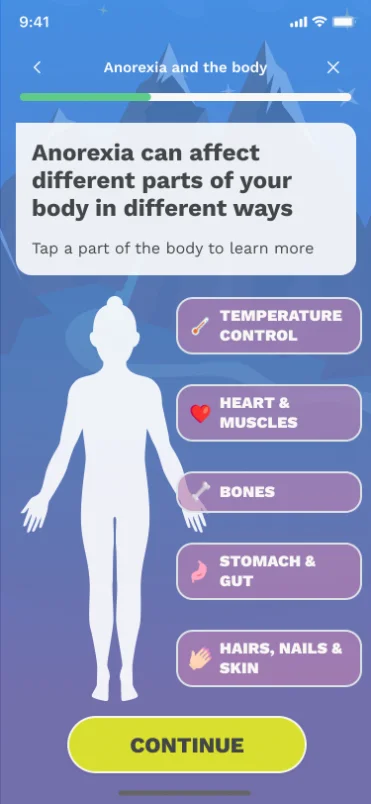
Screenshot: 20 weeks across both apps

20 weeks, two apps

Your weekly modules run a week ahead of your child's, so you know what's coming before they get there.
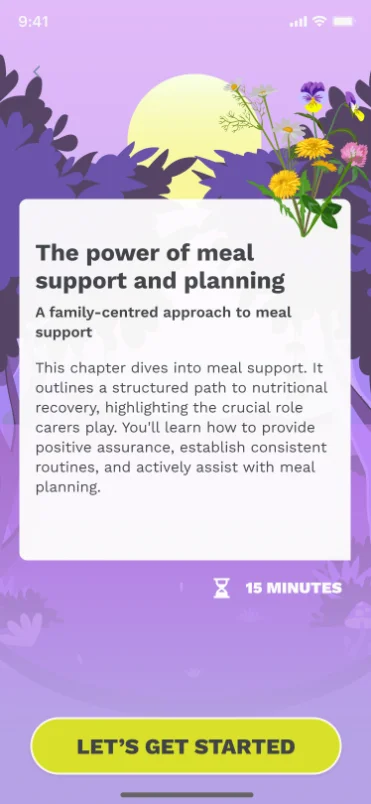
Screenshot: meal planning and support

Meal planning and support

What to plan, what to say, and what to do during those distressing meal times.

Screenshot: diaries

Diaries

Food, thoughts and feelings, recorded simply — and shared with your care team only when you choose.
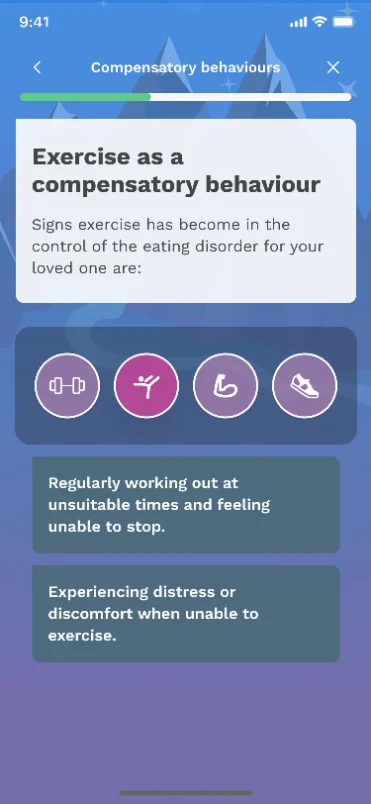
Screenshot: help with the hardest behaviors

Help with the hardest behaviors

Example behaviors such as over-exercise and purging quietly hold recovery back. You'll learn what drives them, how to spot them early, and how to respond.

A few of the things you'll find inside. Behind them sit dozens of modules and videos from families who’ve been there, and other tools to help you and your child.

Twenty weeks. Two apps.
One recovery.

Two connected tracks, moving in sync — because anorexia never affects just one person.

Two connected apps

Twenty weeks, two tracks in sync — one app for your child, one for you. When they reach meal anxiety, yours shows you how to support it.

Your child's track

Understanding the illness, separating themselves from the illness voice, managing anxiety, rebuilding regular eating, and reclaiming their identity.

Your own track

Meal support and Survive & Thrive in-the-moment skills (with Jenny Langley), managing your own exhaustion, and knowing when to hand back control.

Check-ins & shared progress

Daily and weekly check-ins capture your progress and the difficult moments too. With consent, summaries are shared with your team.

See program details and pricing

Real families, real progress

Recovery isn't a straight line — it's a roller coaster. But with the right support, it's real, and common, and worth every small step.

"

He asked if they could just go for a little drive in the car after dinner. Within six months, she was able to go to the ballet in London with her family.

— Caregiver, Univa Care Program

"

We are beginning to see green shoots on meal plan and cognitive function.

— Dad of a son with anorexia

"

Support is amazing and really well designed.

— Mom of a daughter with anorexia

Anorexia moved in uninvited. Help is here today.

Start the program, or book a free call. Today can be the day the waiting ends.

Is this right for me?

What are you facing right now?

Our child has anorexia

Anorexia care program →

This program is not yet available to buy.

We've seen a change — meals skipped, foods cut out, worries about weight or body — but there's no diagnosis
Our child avoids so many foods, and it's not about weight — ARFID, or something like it

ARFID care program →

Still unsure? Book a free call and we'll help you choose.

Questions families ask

No — and you don't have to choose. Univa supports families while they wait and alongside treatment once it starts. The weeks before treatment matter; the program makes them count.
Yes. Start with your caregiver track — skills you use at the table help from day one. Many young people join once they see it as support, not surveillance.
Univa is an evidence-based self-help program and, for many families, a powerful complement to clinical care — not a replacement for medical monitoring. Anorexia carries physical risks, so stay connected with your primary care doctor or clinical team throughout.
The anorexia program is $59 per month.
A mother and daughter paint together at the table, smiling
Anorexia

Your family is the strongest treatment anorexia will ever meet

That's not a slogan — it's what the clinical evidence says. Family therapy is the first treatment recommended for children and young people with anorexia. Univa puts it in your hands: one app for your child, one for you, twenty weeks of structured, evidence-based care. Is this the right program for me? →

Built on proven interventions • Co-created with families in recovery • Clinically developed
A parent helping their child write, side by side

The illness is a visitor, not an identity

Anorexia is a serious mental illness — and you can never tell how unwell someone is by looking at them. Two things matter most for families to know. First: your child is still in there. Caregivers often describe the illness as something that came to visit — a voice that isn't their child's own.

Anorexia is treatable, and families sit at the center of the treatment that works best. This is not something being done to you while you watch. You are part of the medicine.

"

Before the eating disorder came to visit, your loved one had this really vibrant blue balloon — all the things they're good at, the things they like doing, what makes them happy.

— Jenny Langley, Expert Caregiver, Univa Care Program

What families often notice first

Every child is different, but families often notice changes in behavior before anything else: meals becoming tense or avoided, new rules and rituals around food, withdrawal from friends and favourite things, low mood, tiredness, feeling cold, or exercise that feels driven rather than fun.

You don't need to see every sign, or be certain, to act. If your instinct says something is wrong, a primary care doctor appointment is the right first step — and the earlier the better. Anorexia is most treatable when it's met early.

If you're worried about their immediate safety — call 911 or go to the nearest ER. Anorexia carries physical risks, so stay connected with your primary care doctor or clinical team throughout.
A father and daughter walking their dog together in the park

The evidence points home

Parents aren't the cause of anorexia — they're the strongest resource for recovery from it. Univa's program is built on both of the approaches that work.

Family therapy (FT-AN/FBT)

Family therapy is recommended as the first-line psychological treatment for children and young people with anorexia. Decades of research sit behind a simple idea: parents are the strongest resource for recovery.

The New Maudsley approach

Developed at the Maudsley Hospital, it gives caregivers the practical skills: how to respond at the table, how to lower the temperature, and how to look after your own reserves while you do it.

What you'll have in your pocket

Built by the clinicians who treat this, and the families who live it. Two apps that move in step — one for your child, one for you.

Screenshot: 20 weeks across both apps

20 weeks, two apps

Your weekly modules run a week ahead of your child's, so you know what's coming before they get there.

Screenshot: meal planning and support

Meal planning and support

What to plan, what to say, and what to do during those distressing meal times.

Screenshot: diaries

Diaries

Food, thoughts and feelings, recorded simply — and shared with your care team only when you choose.

Screenshot: help with the hardest behaviors

Help with the hardest behaviors

Example behaviors such as over-exercise and purging quietly hold recovery back. You'll learn what drives them, how to spot them early, and how to respond.

A few of the things you'll find inside. Behind them sit dozens of modules and videos from families who’ve been there, and other tools to help you and your child.

Twenty weeks. Two apps. One recovery.

The program runs two connected tracks, because anorexia never affects just one person. When your child reaches a module about meal anxiety, yours shows you how to support it.

Two connected apps

Twenty weeks, two tracks in sync — one for your child, one for you, moving together by design.

Your child's track

Understanding the illness, separating from the illness voice, managing anxiety, rebuilding regular eating, and reclaiming their identity.

Your own track

Meal support and Survive & Thrive skills (with Jenny Langley), managing your own exhaustion, and knowing when to hand back control.

Check-ins & shared progress

Daily and weekly check-ins capture progress. With consent, summaries are shared with your team.

See program details and pricing

Real families, real progress

We won't tell you recovery is a straight line. It's a roller coaster, with steps back as well as forward. But with the right support, recovery from anorexia is real, and common, and worth every small step.

"

He asked if they could just go for a little drive in the car after dinner. Within six months, she was able to go to the ballet in London with her family.

— Caregiver, Univa Care Program

"

We are beginning to see green shoots on meal plan and cognitive function.

— Dad of a son with anorexia

"

Support is amazing and really well designed.

— Mom of a daughter with anorexia

Anorexia moved in uninvited. Help is here today.

Start the program, or book a free 15-minute call to find out more. Today can be the day the waiting ends.

Is this right for me?

Answer one question: what are you facing right now?

Our child has anorexia
Anorexia care program →

This program is not yet available to buy.

We've seen a change — meals skipped, foods cut out, worries about weight or body — but there's no diagnosis
Our child avoids so many foods, and it's not about weight — ARFID, or something like it
ARFID care program →

Still unsure? Book a free 15-minute call and we'll help you choose.

Questions families ask

We're on a waiting list. Should we wait?
No — and you don't have to choose. Univa supports families while they wait and alongside treatment once it starts. The weeks before treatment matter; the program makes them count.
My child isn't ready. Can I start alone?
Yes. Start with your caregiver track — skills you use at the table help from day one. Many young people join once they see it as support, not surveillance.
Is Univa a replacement for clinical treatment?
Univa is an evidence-based self-help program and, for many families, a powerful complement to clinical care — not a replacement for medical monitoring. Anorexia carries physical risks, so stay connected with your primary care doctor or clinical team throughout.
What does it cost?
The anorexia program is $59 per month.
Urgent help now? Call 911 or go to the nearest ER. Call or text 988 (Suicide & Crisis Lifeline).
If your child needs urgent help or you're worried about their immediate safety, call 911 or go to the nearest ER. For crisis support, call or text 988 (Suicide & Crisis Lifeline).
Book a free 15-minute call

A private, no-obligation chat with someone from our family support team. No diagnosis, referral or waiting list needed.

A private, no-obligation chat with someone from our family support team. No diagnosis, referral or waiting list needed.

WHO ARE YOU WORRIED ABOUT?
WHEN SUITS YOU FOR A CALL?
We use these details only to arrange your call.

Your call is booked in

Someone from our family support team will email you within one working day with times that match. Nothing to prepare — just come as you are.

If things feel urgent tonight, call 911 or call or text 988.